Showing posts with label Uruguay. Show all posts

12 Nov 2014

Montevideo (Montevideo, Uruguay)

I've been reading the list of sister cities of my hometown, São Paulo, Brazil, and I noticed some of them don't have official flags. One of them is Montevideo, the capital of Uruguay and one of the best cities in Lati America to live.

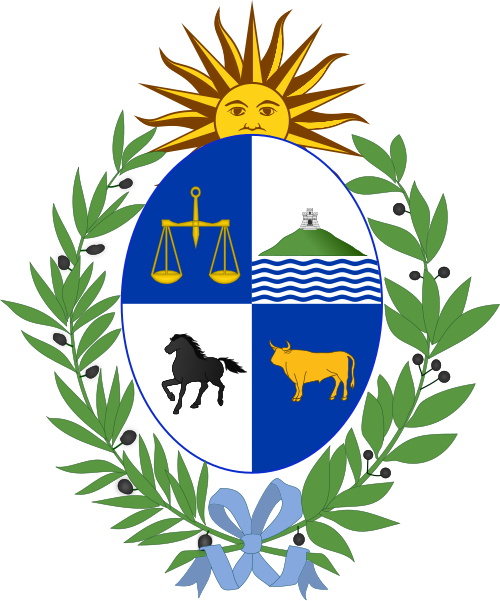
The city, however, has a coat of arms, that appears in the second quarter of the Uruguay's. A previous version contained olive crowns, British colours in the floor, etc. in reference to the decisive participation of the city in the siege of Buenos Aires. The current version, simpler, is the following:


The shield contains a view of the Montevideo hill (cerro) with the respective fortress, now named General Artigas, with a view of the River Plate (Río de la Plata). The shield also reads "Con libertad, ni offendo ni temo", a famous quote by general Artigas that means "With freedom, I neither offend nor fear".

My interpretation of the coat of arms into a flag is the following:


My personal touch was making the river white, a refence to the Río de la Plata, whose name means, literally, "silver's river". The shade of blue is the same of Uruguayan flag.

Comments are welcome.
Sorry for the delay posting this flag. I was busy this week.

3 Sept 2014

Mercosur [car plates]

The Mercosur, a regional bloc comprising Argentina, Brazil, Paraguay, Uruguay and Venezuela, intends to adopt uniform vehicle registration plates, like European Union already did. Trucks and buses must adopt it from 2016, other vehicles from 2018. On recent news, it's possible to see prototypes for the model, that can be seen here. I think the model rather ugly, so I decided for my own attempt.

The plates on the linked image follow the color scheme of respective countries. I'll, at first, design an unified color scheme, totally inspired in Mercosur's flag. They contain the blocs's flag (in Portuguese for Brazil, otherwise in Spanish), the national flags, the countries names in native language and the local identification (already used in Brazil, Uruguay and Venezuela).


I particularly like the layout, and I think it's more similar to the current plates on the countries. I don't think a QR code is needed.

As I early wrote, the basic layout can be adapted to current colors and customs. Below, for example, there are vehicle plates inspired in current Brazilian ones.


I'm particularly happy with the results, because I achieved a clever color scheme with contrasting colors (fundamental to every type of plates).

Comments are welcome.
You can see my post about Mercosur flag here.

2 Jun 2014

Mercosur

The Mercosur (Mercado Común del Sur in Spanish, "Southern Common Market" in English) is a South American political and economical organization, originally comprising Argentina, Brazil, Paraguay and Uruguay; Venezuela joined in 2012, and Bolivia is in admission process. A blog reader called Gonzalez proposed a post about a Mercosur flag that "does not need to be translated".

Gonzalez's worry is based with the fact that the flag that flies on Brazil is this, with "Mercosul" (the name of the organization in Portuguese) inscription. In Brazil, flag law states that this flag should be flown near national flag in many kinds of public bodies.


And, on the rest of the member countries, that speak Spanish, the inscription is "Mercosur":


The symbolism of the flag is interesting: the Southern Cross emerging from horizon is a clear reference to the south, and represents the motto "our north is the south" (a reference to compass' north, used as guide). The fours starts also stand for the four founding members.

An easy solution for the issue is just removing any inscription from the flag and, catching the opportunity, making the stars bigger.


As it would be too easy, I'll propose a more original design, too, presented below:


This flag doesn't have the logo aspect anymore. The white stars on blue seems more natural (it's similar to a Mercosur's unofficial flag variant), and the triangle points to the south, as stated on the motto.

Comments are welcome.
Once more, I'd like to thank the suggestions, and invite you to send me one.

22 May 2014

Colonia del Sacramento (Colonia, Uruguay)

The origins of Colonia del Sacramento (capital of Uruguayan department of Colonia) dates from the Portuguese Colônia do Santíssimo Sacramento ("Colony of the Most Holy Sacrament") settled on the estuary of the River Plate (on the margin, the Argentinean capital, Buenos Aires). For its strategic position, the region was disputed between Portuguese and Spanish settlers; its historic quarter being World Heritage Site due to the mix of both colonial architectonic traditions.

As far as I know, the town doesn't have neither a flag nor any coat of arms. My first inspiration was the famous city's gate, but it can be too generic, maybe. So my next attemp was this:

Blue and white are the Uruguayan colors, and, at the time of city's foundation, both Portugal and Spain used flags with white background. The blue shape is like a fort, a reference to the historic quarter of the city. The sunny white disc is a common representation to the sacramental bread, as the colony was named after the Eucharist, "the most holy sacrament". Again, the sun remembers the Uruguayan national symbols.

Comments are welcome. Please, leave a comment.
If you can locate any Colonia del Sacramento symbol, please cite it on comments.