Showing posts with label Portugal. Show all posts

28 Oct 2014

Portugal: regions

According to 1976 Portuguese Constitution, the country should be divided in administrative regions. It never happened in continental Portugal until then, but Azores and Madeira, in Atlantic Ocean, have their own autonomous regions.

Those regions don't have flags, so I'll give some proposals. The number of proposed regions in continental Portugal is variable, but I'll consider the seven below for this post:

  1. Entre Douro e Minho
  2. Trás-os-Montes e Alto Douro
  3. Beira Litoral
  4. Beira Interior
  5. Estremadura e Ribatejo
  6. Alentejo
  7. Algarve

Seven is more flags than the average by post, so I like some of the flags below more or less.

The first flag I created was to Beira Interior. It's based in the flag flown by the Lusitanian leader Viriatus, that resisted to Roman conquest until his death, in 149 B.C. It's claimed that the flag consisted of a white cloth with a green two-legged dragon. Later, the green dragon became a Portuguese royal symbol.


Other region with a easy flag is Algarve. For long, the title of king of Algarve was subsidiary to that of king of Portugal. Some medieval heralds have attributed arms to the titular kingdom, consisting on a quartered shield with the heads of Saracen and European kings. the other of the heads and the field colors varying.

Firstly, a design with a more contemporary representation, and the armillary sphere from the current flag of Portugal:


Other variation I considered was a banner of arms, with a more Medieval depiction:


The flag of Entre Douro e Minho ("between Douro and Minho rivers") is punning: Douro sounds like "d'ouro" ("of gold"), and a possible etymology of Minho is "red" or "vermillion". The position of the stripes represents, more or less, the disposition of those rivers.


Following, Trás-os-Montes e Alto Douro ("behind the mountains and higher Douro"). I used the same symbolism for Douro, and the green mountains represents the name of Trás-os-Montes and some of its geographical features. I later noticed that the green mountains forms a "M" of Montes ("Mountains"). A curious note is that I have some ancestors from this region of Portugal.


For Alentejo ("beyond the Tejo river"), I designed a flag featuring the yellow of its large camps and the blue of its sky. The darker blue stripe represents the Guadiana river, that divides Portugal and Spain, and where the biggest dam of Western Europe is located.


For Estremadura e Ribatejo ("bounds of Douro and above the Tejo"), a white stripe representing the estuary of Tejo river, with black and white representing Lisbon and purple and white representing Setúbal.


For last, the hardest flag to be design, to Beira Litoral. You can see it below:


The blue cross on white represents the medieval County of Portugal, that would later gives origin to the kingdom of same name. Black and white are the colors of the traditional costumes of the University of Coimbra, one of the them oldest surviving European universities.

Comments are welcome.
The chosen map does not necessarily means I endorse it.

3 Jul 2014

Freamunde (Oporto, Portugal)

Freamunde is a freguesia of Paços de Ferreira, in Oporto district, Portugal. It's known for its Saint Sebastian and its capão (castrated, giant chicken).

In 1991, it was proposed a flag for Freamunde, containing reference to the popular motto "land of culture, labor and peace": an open book, an engine, a chimney and a peace dove. Since then, it started being flown unofficially.


As you can see, the charges of the coat of arms aren't arranged in a blazonable way, so, therefore, it can't be classified as strictly heraldic.

In 2007, the "land without blazons" gained a new, official coat of arms, that you can see on flag below:


I read reports of people that were used by former, unofficial coat of arms and complained against the new one. So I decided to fix the former to a more heraldic layout, using elements from the latter.

Here is my result:


Firstly, I decided to use the same blue and white gironny pattern from both flags. I put the book and the engine in black backgrounds, like the unofficial coat of arms. The capões are white on red background, inspired by the logo of its capões fair. On white background (the color of peace), the olive branch.

I liked the result, because I think it's a nice compromise between the two coats of arms and has a more functional layout.

Comments are welcome.
Sorry for posting thursday, I'm busy this week.

12 Mar 2014

José de Anchieta (1534-1597)

I don't usually design personal flags, so let's see if result is satisfactory. The premise is the following: current pope announced José de Anchieta will be canonized in April 2 and, therefore, he'll be allowed to be regarded as a Catholic saint. He was one of the founders of my home city, São Paulo, and is nicknamed "the apostle of Brazil" for his work of conversion among the natives.

Many saints have their own flags, and I design one to Anchieta . My proposal is the following:


On first and fourth quarters, his family coat of arms as it appears, for example, on the coat of arms of the city of São José dos Campos; I suppose the animal is a bear (blazon isn't clear about it), and I settled the stars as eight-pointed, that's related to Virgin Mary in Christian iconography (he once wrote a 4,172 verses poem for her). On second and third quarters, heads of natives, related to his missionary work. On the center of the flag, the emblem of the Society of Jesus, whereof he was one of first members (he was cousin of Ignatius of Loyola).

I also made a rectangular version of the flag, but I think the square is much superior.

Comments are welcome.
Sorry for small delay on posting it.

24 Dec 2013

Couto Misto (Portugal, Spain)

The Couto Misto (Coto Mixto in Spanish, Couto Mixto in Galician, Couto Misto in Portuguese) was a curious entity in Iberian history. It consisted of a stripe of lands that wasn't owned neither by Spain nor by Portugal, but, actually, a de facto independent republic, whose citizens had many privileges. It lasted until 1864.

There are many proposals to revive the Couto Misto as a Euroregion, a free zone or similar. It consisted of three villages (Santiago de Rubiás, Rubiás and Meaus), that was annexed to Spanish province of Galicia, while the "promiscuous people" and a stripe of uninhabited land was annexed by Portugal.

The ancient flag of Couto Misto is considered a square flag divided vertically in white and blue, colors of Galicia and Portugal. However, I found a text on a report by Ricardo J. Rodrigues that contains the following text:
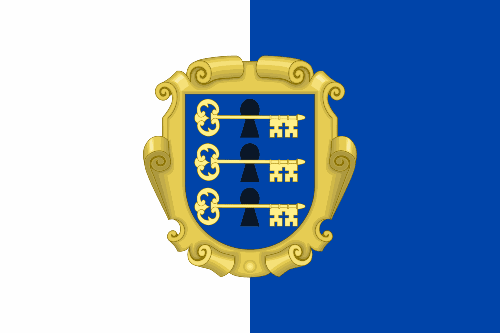
A única novidade é que a mulher de Cesário anda a costurar uma nova bandeira do Couto Misto, que a actual está mais podre do que uma árvore morta. O desenho é o mesmo de sempre: três estrelas dispostas em triângulo e no centro um brasão com três fechaduras.
Translating in English:
The only news is Cesário's wife sewing a new Couto Misto flag, because the current one is more rotten than a dead tree. The design is the same of always: three stars disposed in triangle and a coat of arms with three locks in the center.
Unfortunately, there are missing informations (like colors) that impedes me of reconstructing the flag with exactitude. But the informations are enough to create my own flag proposal:


The locks are an essential symbol of Couto Misto, that relates to its politics: the laws were decided by citizens, then put on a trunk with three locks, that could only be open if the three judges (one nominated by each village, the heads of state of the Couto Misto) agreed, as each one had his own key; honorary judges are annually elected until now. The background of the flag is based on the ancient flag of the country, with a coat of arms with three locks and three keys inserted on a Baroque-style heraldic console (as used by other microstates, like Andorra and San Marino).

This flag could cause awareness of the history and status of Couto Misto, and could be used alternatively to the ancient flag and the flag described on the fragment above.

Your comments are welcome.
I'd like to desire a Merry Christmas and an excellent 2014 to all readers of the blog.

3 Dec 2013

Iberian Union

Last week, Samuel McKittrick released, on his blog, an excellent post about an Iberian peninsular flag. Although it's unclear if European Union is good or bad for a future federation or confederation between Portugal and Spain, being Latin American, I'm personally favorable to stronger ties between the two countries, specially in cultural aspects.

Below, you'll find the currently most popular Iberist flag, followed by two designs by Sammy:
Proposal by Sinibald di Mas i Sans (1854), with the colors of Portugal coat of arms (blue and white, also used in then flag) and the colors of Spanish flag (red and yellow).

Proposal #1 by Samuel McKittrick, with the union of both Spanish and Portuguese flags, and coat of arms of Spain with Portugal in highlight position.

Proposal #2 by Samuel McKittrick, with the union of both Spanish and Portuguese flags, and two stars for the two countries.

I like the designs, but I decided it would be fun to go on a different approach. Here's what I came:

This design is inspired by Union Jack and other similar designs. The blue cross on white was the first coat of arms of Portugal, and survives on current coat of arms of that country. The knotted (said raguly in heraldic language) red saltire on white is the famous "cross of Burgundy", used as merchant ensign (specially in former Spanish America), among other uses, and still present on the personal coat of arms of Spanish monarchs. I also made versions with the cross of Order of Christ in red and blue.

As a bonus, a what-if. Portugal and Spain had a joint candidate to host the 2018 football World Cup. If they won, I think this design, inspired by candidature logo, could be used to promote the tournament:

Your comments are welcome.
Don't forget to visit Sammy's post here.

3 Apr 2013

Mirandese language (Portugal)

The Mirandese language (Mirandés) is a co-official language in Portugal (along with Portuguese). It's a language of Astur-Leonese group, spoken in good part of Miranda do Douro council, two parishes of Vimioso and one village of Mogadouro, with smaller influence on neighbor regions. I've seen many flags presented as proposals to this language (see examples there and there), so I thought about giving my own proposal.

To represent the Mirandese language, it's used the flag of the municipality of Miranda do Douro, sometimes used to represent the whole council:


A flag consisting in a banner of arms of the previous coat of arms could be misunderstood as a flag only centered on Miranda do Douro council, although the idea could be reused.

My proposal is the following:


I moved the Miranda do Douro arms to first canton (the position of honor), for being synonym to Mirandese language. The other three quarters represent the other regions where Mirandese is spoken, that are widely three: the two parishes of Vimioso and the village of Mogadouro. The blue cross fimbriated in white represents the first flag of Portugal, for the fact that the Mirandese is identified with Portugal.

Comments are very welcome! Feel free to comment.
Click here to access an interesting site about the Mirandese language.