Showing posts with label Africa. Show all posts

2 Sept 2015

Nubia (Egypt / Sudan)

The Nubia region is currently divided between Egypt and Sudan. I've saw a Facebook post about the nonexistence of a flag for Nubian people (even though proposals exist). So this is my take.

I've designed the following design:


A white crescent on blue background is reported as a symbol of Nubia in European medieval maps. The blue color can also stand for the Nile, while the crescent can represent the predominantly Muslim population. I've added a golden-yellow stripe on fly, representing the desert, but also the old glories e.g. Kush.

I'm not a specialist in Nubia, so I can only hope that my vision is correct. As a design, I like it very much.

Comments and suggestions are welcome.
My computer is starting to work again. So posting frequence may re-normalize.

11 Jun 2015

British Overseas Territories (United Kingdom)

Let's take a careful look at Gibraltar's flag:

Why is this different from any other British overseas' flag? Because it don't have an Union Jack on it. Now, look at the flag of the other fifteen British overseas territories:

Akrotiri and DhekeliaAnguillaAscension
BermudaBritish Antarctic TerritoryBritish Indian Ocean Territory
British Virgin IslandsCayman IslandsFalklands Islands
MontserratPitcairnSaint Helena
South Georgia and South
Sandwich Islands
Tristan da CunhaTurks and Caicos

Quite boring, isn't it? So today I'll present my proposal for the fifteen! Some of the designs are mine, others aren't (when noted).

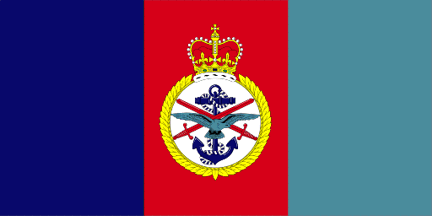
My design for Akroitiri and Dhekelia is inspired by the Dhekelia Garrison's flag. For difference, I've added the colors of British Ministry of Defence, to show it's a military base.


My proposal for Anguilla is actually a rip-off of Republic of Anguilla (1967-1969) flag i.e. a banner of current arms.


For Ascension, a banner of arms, too. I added a tiny white fimbriation in the green chevron, just to increase visibility:


For Bermuda, I picked the lion and red of current flag (both representing British influence) but put the lion's face on a triangle, a reference to famous Bermuda's triangle.


My British Antarctic Territory flag proposal is based on coat of arms, too. I put the blue stripes on center and made the white background shine.


For British Indian Ocean Territory, I picked the flag of Chagossians (natives) in exile and put the palm tree and crown from current design. Some minor details is that I put the crown crossing the tree and centered in black stripe, for better aesthetics. This is one of my favorite flags in the series.


Also original is my flag for the British Virgin Islands. The lamp refers to Saint Ursula and the 11,00 martyred handmaidens that give the islands its name. The four stars represent the four main islands: Tortola, Virgin Gorda, Anegada and Jost Van Dyke.


My proposal for Cayman Islands is a simplification of current coat of arms; this design, actually, was reportedly once used by independentist movement.


My flag for Falkland Island is freely inspired in the coat of arms. I removed the ship and shifted the flag for the hoist for aesthetic reasons.


The flag of Montserrat represent, basically, the island of Ireland (due to physical similarities and the origin of many settlers) and the cross. So I made the following design:


Another of my favorite design on the series is that of Pitcairn. It's, basically, a rotated and simplified version of the coat of arms.


For Saint Helena, I kept the symbol bird of the territory, but added a cross in red and yellow in reference to Byzantine empress Saint Helena, that, according to tradition, found the True Cross.


I rotated and simplified the coat of arms of South Georgia and South Sandwich Islands. Now, the two wavy stars represent both James Cook and the two island chains (South Georgia and South Sandwich) that gives the territory its name.


The flag of Tristan da Cunha is just the striking banner of arms:


Finally, my proposal for Turks and Caicos. I couldn't satisfactorily harmonize the three charges of its coat of arms, so I used yellow for sand, green for the flora, pink for the shell and the flamingoes and a lobster as lone charge.


Comments and suggestions are welcome.
Sorry for the delay; I hope the long post is enough sorry.

23 Apr 2015

Cabinda (Angola)

Cabinda is a province that happens to be an Angolan pene-exclave (three fourths foreign lands, one fourth the sea). It's an area of conflict between Angolan government and secessionists, that believe that, in the terms of the Treaty of Simulambuco and other documents, although de facto administered as part of Angola it was a de jure separate subject to Portuguese republic before Angolan independence.

As far as I know, there isn't a Cabinda flag. Those flags one can find actually pertain to certain to those secessionist movement. So I decided to create a flag that represents Cabinda uniqueness, but as neutral as I could.

My inspiration for this flag is the Monument of Simulambuco, located where the treaty of same name, incorporating Cabinda as a then-Portuguese Crown's protectorate.


The three spears in front of it represent the kingdoms of Kakongo, Loango, and N'Goyo. I incorpotated them in the flag, but in a different way:


The blue color represents the Atlantic Ocean. The design could be mirrored, if one prefer:


I like the visual experiment with the arrows. The result is surely striking.

Comments and suggestions are welcome.
Sorry for the delay, again.

17 Dec 2014

La Graciosa (Canary Islands, Spain)

Among the Canary inhabitated islands, La Graciosa is the only without a flag. Trying to solve this, local inhabitant Jesús Manuel Páez started an online poll asking people's opinion about his design.

Here, you can my rendition of his design:


This flag is based in previous ideas, as can be read here. The two blue stripes represents the sky and the sea. The middle stripe forms the silhouette of La Graciosa and neighbor islets.

I'm not so sure about the design, as the silhouette is not very obvious, to say the least. José Manuel Erbez Rodríguez created the following proposal, a much more ellegant design on same theme:


Without pretensions of beating Erbez's design, I decided to make my own contribution:


Yellow for sand, blue for the light sea. The cauldron is punning to the Playa de la Cocina (cocina = kitchen, cuisine), one of most important beaches in Canary Islands, and commonly found in regional heraldry. The two stars represent the two settlements in the island: Caleta de Sebo and Casas de Pedro Barba.

As I couldn't find similar design, and some Canarian flags are really simple, this design could also be used:


Comments and suggestions are welcome.
I'll be traveling next weeks, so hiatuses can occur.

17 Sept 2014

Bir-Tawil, Hala'ib Triangle

While Egypt held Sudan in a condominium with United Kingdom, there were distinct political and administrative between the two countries; with Sudanese independence, both countries claims the Halai'b Triangle for themselves (making it a disputed territory), but Bir-Tawil for the others (making it a de jure terra nullius).

Due to the unclear sovereignity over these two areas, I intended to design "neutral" flags, that could be used by the two sides indistinctly. Both flags used pan-Arab colors.

For Bir-Tawil, I made the following design:

Both Egypt and Sudan use red-white-black (in this exact order) horizontal tricolor flags. The white trapezium represents the shape of the area and its location between the two countries. Red represents the Egyptian desert, as the Ancient Egyptians used to distinguish the black, floodable "black land" from the desertic "red land". Black represents Sudan's name etymology, "black man".

The Hala'ib Triangle flag has the geometrical shape that the area its name:

As explained for the previous flag, the black color represents both Sudan and the fertile Egypt. The red stripe in the fly represents the Red Sea. The triangle is obvious.

I think the result was two unique flags, but still very simple.

Comments and suggestions are welcome.
Please, no politics on the comments.

26 Aug 2014

Angola

After my post about Luanda, the capital of Angola, an anonymous commenter asked me about a "less politically loaded" flag for the country.

It's the current flag of the country:


The flag is strongly inspired by the flag of MPLA, the ruling party of Angola since its independence. Red used to stand for socialism, but, in current representation, represents courage and the blood shed; black stands for Africa. The central elements, inspired by the Soviet flag, represent the workers of the country.

An interesting starting point can be the flag that Angola almost adopted last decade:


The red color has the same symbolism of current flag. Blue stands for freedom, justice and solidarity; white, for peace, unity and harmony. The central element is a sun drawn in native art style. I think the sun element is too logo-ish to stand in the national flag.

So, my attempt resulted in the following flag:


The white fimbriations are purposedly big, representing the intended peace and harmony between the people and the parties after the end of the civil war. The blue, from the proposed flag, represent principles (freedom, justice, solidarity) that should be seeked; the red is present in the flag of Angola's three main parties (MPLA, UNITA and FNLA), and stands for the courage, heroism and blood; black stands for the African and Angolan people, and is an additional link for Pan-African colors.

My proposal presents only a tiny similarity to current national flag, and I hope it's acceptable both by likers and dislikers of current one. Its boldness and strong symbolism is, of course, something essential to a successful national flag.

Comments and suggestions are welcome.
The surprise I prepared to this week had to be postoponed to reasons out of my control. I'm sorry.

20 Aug 2014

Luanda (Angola)

Luanda is the capital of Angola. Brazil and Angola, being two parts of Lusophony with shared history, developed a close friendship. Luanda, for example, is friend city of my hometown, São Paulo.

As far as I know, Luanda doesn't have a flag. It acquired a coat of arms while still part of Portuguese Angola, but I couldn't check if it's still used:


This flag showed Our Lady of the Assumption in a blue field, and St. Paul in a red field. Those were the patron saints of Luanda, and its full name was "St. Paul of Assumption of Luanda".

Inspired by the coat of arms, I designed the following flag:


The symbol in the middle of the flag is a stylized cowry, formerly used as currency in many parts of Africa and the world. It represents the shell money extracted in the island of Luanda, but also the wealth of the city and its African roots; it's also related to one of probable origins of city's name.

Comments are welcome.
I have exciting news for next week. Wait!

15 Jan 2014

Dahlak Archipelago (Eritrea)

This post came from a thread on Flags Forum about flags for some African regions (access the link to see this and other proposals). The Dahlak islands is an archipelago located in Red Sea that belongs to Eritrea.

My proposal on that thread was the following:

The main feature of the flag are the shells. The pearl fishing on the islands is famous since Roman times and was once among the most importants of the world. Today, its relevance isn't the same, but it still exists (including as a touristic attraction, together with scuba diving). Having a pearl a generic circular flag, shells were chosen for more direct identification. The flag have four shells, as four are the inhabited islands of the archipelago.

The white color can also represent the white beach and the limpid waters of Dahlak. The red color is chosen as a reference to the Red Sea, and to the Islamism (islanders were converted yet on 7th century).

An alternative proposal have white circles (representing pearls) instead of white shells, making it simpler but more generic.

Your comments are very welcome.
Remembering you can access the Flags Forum thread here.