Miskito people is a Native American people native from Caribbean coast of Nicaragua and south Honduras, historically called "Mosquito Coast" (not related to the insect).
Sparsely inhabitated by Spanish colones, the Mosquito coast was twice in its history a British protectorate. In the second time (1844-1860), this flag was used:
From 1860 until 1894, where the area was finally annexed by Nicaragua (Honduras would only gain its piece in 1960), this flag was flown:
In that flag, the British flag was substituted by a version of Nicaragua flag, but with Miskito royal coat of arms instead. Until today, Miskito people use variations of these flags (you can find more about their flags here).
I imagined a hypothetical flag without British or monarchical symbolism, to avoid misinterpretations. I opted out for Nicaraguan symbolism for its busyness, nor plain stripes, as their are already often used. The result was this:
Eight stripes were common variations of these ten stripes flags. The symbol with a spear, shovel and canoe is used by the Council of Elders, among other Miskito entities. The two stars represent Honduras and Nicaragua, respective to their geographical locations. I think the colour palette represents the jungle and the coast very well.
Comments and suggestions are welcome.
So sorry for not posting nothing last week. I had technical issues.
Showing posts with label Central America. Show all posts
29 Sept 2015
Miskito people (Nicaragua / Honduras)
11 Jun 2015
British Overseas Territories (United Kingdom)
Let's take a careful look at Gibraltar's flag:
Why is this different from any other British overseas' flag? Because it don't have an Union Jack on it. Now, look at the flag of the other fifteen British overseas territories:
Quite boring, isn't it? So today I'll present my proposal for the fifteen! Some of the designs are mine, others aren't (when noted).
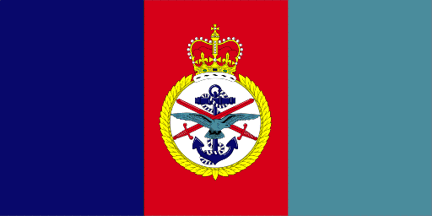
My design for Akroitiri and Dhekelia is inspired by the Dhekelia Garrison's flag. For difference, I've added the colors of British Ministry of Defence, to show it's a military base.

My proposal for Anguilla is actually a rip-off of Republic of Anguilla (1967-1969) flag i.e. a banner of current arms.

For Ascension, a banner of arms, too. I added a tiny white fimbriation in the green chevron, just to increase visibility:

For Bermuda, I picked the lion and red of current flag (both representing British influence) but put the lion's face on a triangle, a reference to famous Bermuda's triangle.

My British Antarctic Territory flag proposal is based on coat of arms, too. I put the blue stripes on center and made the white background shine.

For British Indian Ocean Territory, I picked the flag of Chagossians (natives) in exile and put the palm tree and crown from current design. Some minor details is that I put the crown crossing the tree and centered in black stripe, for better aesthetics. This is one of my favorite flags in the series.

Also original is my flag for the British Virgin Islands. The lamp refers to Saint Ursula and the 11,00 martyred handmaidens that give the islands its name. The four stars represent the four main islands: Tortola, Virgin Gorda, Anegada and Jost Van Dyke.

My proposal for Cayman Islands is a simplification of current coat of arms; this design, actually, was reportedly once used by independentist movement.

My flag for Falkland Island is freely inspired in the coat of arms. I removed the ship and shifted the flag for the hoist for aesthetic reasons.

The flag of Montserrat represent, basically, the island of Ireland (due to physical similarities and the origin of many settlers) and the cross. So I made the following design:

Another of my favorite design on the series is that of Pitcairn. It's, basically, a rotated and simplified version of the coat of arms.

For Saint Helena, I kept the symbol bird of the territory, but added a cross in red and yellow in reference to Byzantine empress Saint Helena, that, according to tradition, found the True Cross.

I rotated and simplified the coat of arms of South Georgia and South Sandwich Islands. Now, the two wavy stars represent both James Cook and the two island chains (South Georgia and South Sandwich) that gives the territory its name.

The flag of Tristan da Cunha is just the striking banner of arms:

Finally, my proposal for Turks and Caicos. I couldn't satisfactorily harmonize the three charges of its coat of arms, so I used yellow for sand, green for the flora, pink for the shell and the flamingoes and a lobster as lone charge.

Comments and suggestions are welcome.
Sorry for the delay; I hope the long post is enough sorry.
Why is this different from any other British overseas' flag? Because it don't have an Union Jack on it. Now, look at the flag of the other fifteen British overseas territories:
Quite boring, isn't it? So today I'll present my proposal for the fifteen! Some of the designs are mine, others aren't (when noted).
My design for Akroitiri and Dhekelia is inspired by the Dhekelia Garrison's flag. For difference, I've added the colors of British Ministry of Defence, to show it's a military base.

My proposal for Anguilla is actually a rip-off of Republic of Anguilla (1967-1969) flag i.e. a banner of current arms.

For Ascension, a banner of arms, too. I added a tiny white fimbriation in the green chevron, just to increase visibility:

For Bermuda, I picked the lion and red of current flag (both representing British influence) but put the lion's face on a triangle, a reference to famous Bermuda's triangle.

My British Antarctic Territory flag proposal is based on coat of arms, too. I put the blue stripes on center and made the white background shine.

For British Indian Ocean Territory, I picked the flag of Chagossians (natives) in exile and put the palm tree and crown from current design. Some minor details is that I put the crown crossing the tree and centered in black stripe, for better aesthetics. This is one of my favorite flags in the series.

Also original is my flag for the British Virgin Islands. The lamp refers to Saint Ursula and the 11,00 martyred handmaidens that give the islands its name. The four stars represent the four main islands: Tortola, Virgin Gorda, Anegada and Jost Van Dyke.

My proposal for Cayman Islands is a simplification of current coat of arms; this design, actually, was reportedly once used by independentist movement.

My flag for Falkland Island is freely inspired in the coat of arms. I removed the ship and shifted the flag for the hoist for aesthetic reasons.

The flag of Montserrat represent, basically, the island of Ireland (due to physical similarities and the origin of many settlers) and the cross. So I made the following design:

Another of my favorite design on the series is that of Pitcairn. It's, basically, a rotated and simplified version of the coat of arms.

For Saint Helena, I kept the symbol bird of the territory, but added a cross in red and yellow in reference to Byzantine empress Saint Helena, that, according to tradition, found the True Cross.

I rotated and simplified the coat of arms of South Georgia and South Sandwich Islands. Now, the two wavy stars represent both James Cook and the two island chains (South Georgia and South Sandwich) that gives the territory its name.

The flag of Tristan da Cunha is just the striking banner of arms:

Finally, my proposal for Turks and Caicos. I couldn't satisfactorily harmonize the three charges of its coat of arms, so I used yellow for sand, green for the flora, pink for the shell and the flamingoes and a lobster as lone charge.

Comments and suggestions are welcome.
Sorry for the delay; I hope the long post is enough sorry.
Labels:
Africa,
Asia,
Central America,
Europe,
North America,
Oceania,
South America,
United Kingdom
7 Apr 2015
Organization of American States
The Organization of American States (OAS or OEA) is an international organization consisting in all independent countries of the Americas (Cuba is not active member).
Its flag is similar to the following:

It contains OAS' logo (pieces of the flags of the member states in a flagpole) in a blue background. I consider this design cluttered and lazy.
I came up with a proposal of my own, just to discover that Flags Forum's user Smertios had a similar idea much earlier:

I think the idea of an stylized map is clever, but I'm not happy with its (possibly unintentional) similarity with logo of FTAA, a proposed pan-American (except Cuba) free-trade area.
My actual design, developed independently, is the following:

I kept the basic white-circle-on-blue design, but thought the circle like a globe. I painted the continent red because it's a color widely associated with American continent e.g. the former rationale for Olympic red ring.
Comments are welcome.
I tried to make this post the most apolitical.
Its flag is similar to the following:

It contains OAS' logo (pieces of the flags of the member states in a flagpole) in a blue background. I consider this design cluttered and lazy.
I came up with a proposal of my own, just to discover that Flags Forum's user Smertios had a similar idea much earlier:

I think the idea of an stylized map is clever, but I'm not happy with its (possibly unintentional) similarity with logo of FTAA, a proposed pan-American (except Cuba) free-trade area.
My actual design, developed independently, is the following:

I kept the basic white-circle-on-blue design, but thought the circle like a globe. I painted the continent red because it's a color widely associated with American continent e.g. the former rationale for Olympic red ring.
Comments are welcome.
I tried to make this post the most apolitical.
Labels:
Central America,
North America,
South America
15 Oct 2014
Caribbean Netherlands / BES islands (Netherlands)
The Caribbean Netherlands, also known as BES islands - because of the name of constituent Bonaire, Sint Eustatius and Saba - emerged from the dissolution of Netherlands Antilles in 2011, together with now autonomous Curaçao and Sint Maarten.
Since then, the Netherlands Antilles lost its status as recognized Olympic committtee, the athletes competing in 2011 Pan-American Games and 2012 Olympic Games under PASO and IOC flags, respectively. It's not improbable that Curaçao ans Sin Maarten will gain any time their own separate Olympic committees, but SEB islands may not have same lucky and, currently, they can only compete under Aruba or Netherlands flags.
My first proposal was one of the first flags that I designed seriously, probably before the existance of this blog, so you can see some faults. Here's it, unedited:

This flag was inspired by the logo of the National Office for the Caribbean Netherlands (below), with Olympic rings and colors associated with Dutch sports:

I recently re-thought about the theme. My solution, much simpler than the previous, is the following:

It's a very simple idea: the Dutch flag, with wavy stripes (representing the insular aspect of the region), and the Olympic rings. Bonaire, Saba and Sint Eustatius all have red, white and blue in their flags.
For non-sportive contexts, you can see this:

It's very simple, but, in some visibility conditions, can be too similar to Dutch national flag.
Comments are welcome.
RCN logo used under fair use.
Since then, the Netherlands Antilles lost its status as recognized Olympic committtee, the athletes competing in 2011 Pan-American Games and 2012 Olympic Games under PASO and IOC flags, respectively. It's not improbable that Curaçao ans Sin Maarten will gain any time their own separate Olympic committees, but SEB islands may not have same lucky and, currently, they can only compete under Aruba or Netherlands flags.
My first proposal was one of the first flags that I designed seriously, probably before the existance of this blog, so you can see some faults. Here's it, unedited:

This flag was inspired by the logo of the National Office for the Caribbean Netherlands (below), with Olympic rings and colors associated with Dutch sports:

I recently re-thought about the theme. My solution, much simpler than the previous, is the following:

It's a very simple idea: the Dutch flag, with wavy stripes (representing the insular aspect of the region), and the Olympic rings. Bonaire, Saba and Sint Eustatius all have red, white and blue in their flags.
For non-sportive contexts, you can see this:

It's very simple, but, in some visibility conditions, can be too similar to Dutch national flag.
Comments are welcome.
RCN logo used under fair use.
Labels:
Bonaire,
Central America,
Netherlands,
Saba,
Sint Eustatius
22 Apr 2014
Italian diaspora in Americas
A virtual friend, Hosmich, asked some time ago about a flag for the Italian and Italian-descendant people that lives in the Americas. Why? If you look at my surname, you may have noticed I have some Italian ancestry. Italian diaspora is very relevant in countries such Argentina, Uruguay, Brazil, USA, Canada, Peru and Venezuela.
After some thought, I did this design:
As the Italian reunification only occurred in the 19th century, there isn't a long tradition of Italian national symbols. One of them is the stella d'Italia ("star of Italy"), that dates from the first millenium after Christ. It's often associated with the story of the morning star guiding Aeneas, considered by Virgil's Aeneid the legendary founder of Rome. It appears on current Italian national emblem.
The rays on the colors of Italian flag was inspired by this propaganda piece dating from WW1. Specifically to Americas, I chose the purple color, from a Pan-American flag.
Comments are welcome.
Much thanks to Hosmich by the suggestion.
Labels:
Central America,
North America,
South America
21 Oct 2013
US Virgin Islands (USA)
Last week, Samuel McKittick posted on his blog two proposasl to a new flag for the US Virgin Islands.
The current flag of US Virgin Islands:

After presenting arguments to flag change, Sammy presented the following proposals:
The premise of the proposals by Sammy is very well-thought: before being an American territory, the US Virgin Islands were part of the Danish West Indies. His first design is the Danish flag, with three blue stars on a navy blue background (reference to USA flag) representing the three main islands. His second proposal uses light blue (more similar to the flag of Danish West Indies) and yellow, representing the bananaquit, the national bird of the islands.
The good designs of Sammy gave me an idea to a third design that could be considered. This is it:

Firstly, I changed the star arrangement, to be more similar to the map of the islands and heraldically more traditional. The idea behind this design is to make the Danish flag emulated red and white stripes i.e. the flag of United States, representing the former and the current owners of the islands once.
To a more colorful, we can think on adding bananaquit's yellow:

This design has a much more subtle reference to American flag, what can be a potential fault, but adds local significance and the Caribbean flags' colorfulness.
Your comments are welcome.
Samuel McKittrick's post is very complete and explains more detailed the rationale of his designs. Click here to read it.
The current flag of US Virgin Islands:

After presenting arguments to flag change, Sammy presented the following proposals:
![]() | ![]() |
| Proposal #1 (by Samuel McKittrick) | Proposal #2 (by Samuel McKittrick) |
The premise of the proposals by Sammy is very well-thought: before being an American territory, the US Virgin Islands were part of the Danish West Indies. His first design is the Danish flag, with three blue stars on a navy blue background (reference to USA flag) representing the three main islands. His second proposal uses light blue (more similar to the flag of Danish West Indies) and yellow, representing the bananaquit, the national bird of the islands.
The good designs of Sammy gave me an idea to a third design that could be considered. This is it:

Firstly, I changed the star arrangement, to be more similar to the map of the islands and heraldically more traditional. The idea behind this design is to make the Danish flag emulated red and white stripes i.e. the flag of United States, representing the former and the current owners of the islands once.
To a more colorful, we can think on adding bananaquit's yellow:

This design has a much more subtle reference to American flag, what can be a potential fault, but adds local significance and the Caribbean flags' colorfulness.
Your comments are welcome.
Samuel McKittrick's post is very complete and explains more detailed the rationale of his designs. Click here to read it.
3 Sept 2013
West Indies zone
In cricket, many nations of Caribbean compete under "West Indies" umbrella. Most of its members belonged to former British West Indies, although it also includes American and Dutch dependencies. It's formed by six minor associations: Barbados, Guyana, Jamaica, Trinidad and Tobago, Leeward Islands and Windward Islands (the later two subdivided in smaller associations).
The idea of this post is based on the fact that there isn't a representative flag of West Indies. Generally, the flag of the West Indies Cricket Board is used, but it's copyrighted and can't represent the region in a different context. It's WICB flag:
For this purpose, the flag should be as generic as possible, as West Indies area is constituted by countries with their own diversity. But, if possible, it should resembles to WICB logo and, in lesser scale, the West Indies Federation flag.
The wavy pattern and the golden disc comes from both the WICB logo and Federation flag. The palm tree is a feature of IWCB logo[ and a well-known symbol of the Caribbean. The sun disc was moved from the right to the left, to form a more equilibrated layout.
This flag can be carried by West Indies fans, included as handmade pieces. There isn't any symbol that attaches it necessarily to cricket, being possibly used in other contexts. And this flag isn't copyrighted and can be customized.
Your comments are welcome!
The blog doesn't have many posts related to Central Americas. I'm accepting suggestions.
The idea of this post is based on the fact that there isn't a representative flag of West Indies. Generally, the flag of the West Indies Cricket Board is used, but it's copyrighted and can't represent the region in a different context. It's WICB flag:
For this purpose, the flag should be as generic as possible, as West Indies area is constituted by countries with their own diversity. But, if possible, it should resembles to WICB logo and, in lesser scale, the West Indies Federation flag.
The wavy pattern and the golden disc comes from both the WICB logo and Federation flag. The palm tree is a feature of IWCB logo[ and a well-known symbol of the Caribbean. The sun disc was moved from the right to the left, to form a more equilibrated layout.
This flag can be carried by West Indies fans, included as handmade pieces. There isn't any symbol that attaches it necessarily to cricket, being possibly used in other contexts. And this flag isn't copyrighted and can be customized.
Your comments are welcome!
The blog doesn't have many posts related to Central Americas. I'm accepting suggestions.
13 Dec 2012
Abaco Islands (Bahamas)
Do you know where Abaco Islands are? Probably not, except if you're Bahamian or collect bad flags. Because the islands sure have one of them. Actually, it's not the local flag, that they apparently haven't, but the flag of the (apparently) defunct Abaco Independence Movement, that wanted to became a separated British colony (there was even a proposed governor flag). For now, I should say I'll keep politically neutral on this post.
The flag isn't very good (in some depictions, it's showed even worse). There's a lot of problems on it. Firstly, the flag is overloaded on the right, what means that, on low wind, the flag is indistinguishable. I count seven colors on it (blue, yellow, orange, red, white, gray and black). Too many, for me. And this lighthouse (it's a lighthouse, if you haven't perceived yet) looks like the Tower of Pisa, but it's very straight.
I'll keep the same elements of this flag, only create a better pattern. The lighthouse represents the Hope Town Lighthouse, the islands' most famous landscape. The sun represents freedom on original design, but I'll use as reference to local climate.
The result isn't as good as I wanted, but's still better than the original flag. The flag is more symmetric now, and I preferred the stylized lighthouse in place of the more "cartoonish" one. Four colors are still very many, but obviously less than seven. It's my self-concept to this proposal: not excellent, but better than the original.
Your comment is welcome. Please, leave a comment.
But I'll repeat: I'll not express my personal opinion on Abaco issue. We're only discussing vexillology.
This interpretation of the flag is from there.
I know that was a long time since I published my last post, but I promised it'll return to standard rhythm on January.
The flag isn't very good (in some depictions, it's showed even worse). There's a lot of problems on it. Firstly, the flag is overloaded on the right, what means that, on low wind, the flag is indistinguishable. I count seven colors on it (blue, yellow, orange, red, white, gray and black). Too many, for me. And this lighthouse (it's a lighthouse, if you haven't perceived yet) looks like the Tower of Pisa, but it's very straight.
I'll keep the same elements of this flag, only create a better pattern. The lighthouse represents the Hope Town Lighthouse, the islands' most famous landscape. The sun represents freedom on original design, but I'll use as reference to local climate.
The result isn't as good as I wanted, but's still better than the original flag. The flag is more symmetric now, and I preferred the stylized lighthouse in place of the more "cartoonish" one. Four colors are still very many, but obviously less than seven. It's my self-concept to this proposal: not excellent, but better than the original.
Your comment is welcome. Please, leave a comment.
But I'll repeat: I'll not express my personal opinion on Abaco issue. We're only discussing vexillology.
This interpretation of the flag is from there.
I know that was a long time since I published my last post, but I promised it'll return to standard rhythm on January.
Subscribe to:
Posts (Atom)