Showing posts with label Spain. Show all posts

28 Oct 2015

Valencia (Valencian Community, Spain)

Valencia is the capital and biggest city of Valencian Community and former Kingdom of Valencia. It uses the same, historical flag of Valencian Communtiy, so I thought about a design only for the city.

This is the flag:


It the senyera of former Crown of Aragon (nine yellow-red horizontal stripes) with a stylized crown, a privilege dating from the second half of 14th century.

My proposal takes the crest from current coat of arms — probably originary from belief that Crown of Aragon's crest contained a bat instead of a wyvern — and puts it on a cairó, a rotated square associated there with civic heraldry. This is the result:


This crest, being golden and black, is very hard to contrast. In my second attempt, I used a more pan-Catalan color scheme:


I'm more inclined towards second scheme, but I think Valencian people would be proud of both.

Comments and suggestions are welcome.
Which one of designs do you prefer?

17 Dec 2014

La Graciosa (Canary Islands, Spain)

Among the Canary inhabitated islands, La Graciosa is the only without a flag. Trying to solve this, local inhabitant Jesús Manuel Páez started an online poll asking people's opinion about his design.

Here, you can my rendition of his design:


This flag is based in previous ideas, as can be read here. The two blue stripes represents the sky and the sea. The middle stripe forms the silhouette of La Graciosa and neighbor islets.

I'm not so sure about the design, as the silhouette is not very obvious, to say the least. José Manuel Erbez Rodríguez created the following proposal, a much more ellegant design on same theme:


Without pretensions of beating Erbez's design, I decided to make my own contribution:


Yellow for sand, blue for the light sea. The cauldron is punning to the Playa de la Cocina (cocina = kitchen, cuisine), one of most important beaches in Canary Islands, and commonly found in regional heraldry. The two stars represent the two settlements in the island: Caleta de Sebo and Casas de Pedro Barba.

As I couldn't find similar design, and some Canarian flags are really simple, this design could also be used:


Comments and suggestions are welcome.
I'll be traveling next weeks, so hiatuses can occur.

12 Mar 2014

José de Anchieta (1534-1597)

I don't usually design personal flags, so let's see if result is satisfactory. The premise is the following: current pope announced José de Anchieta will be canonized in April 2 and, therefore, he'll be allowed to be regarded as a Catholic saint. He was one of the founders of my home city, São Paulo, and is nicknamed "the apostle of Brazil" for his work of conversion among the natives.

Many saints have their own flags, and I design one to Anchieta . My proposal is the following:


On first and fourth quarters, his family coat of arms as it appears, for example, on the coat of arms of the city of São José dos Campos; I suppose the animal is a bear (blazon isn't clear about it), and I settled the stars as eight-pointed, that's related to Virgin Mary in Christian iconography (he once wrote a 4,172 verses poem for her). On second and third quarters, heads of natives, related to his missionary work. On the center of the flag, the emblem of the Society of Jesus, whereof he was one of first members (he was cousin of Ignatius of Loyola).

I also made a rectangular version of the flag, but I think the square is much superior.

Comments are welcome.
Sorry for small delay on posting it.

24 Dec 2013

Couto Misto (Portugal, Spain)

The Couto Misto (Coto Mixto in Spanish, Couto Mixto in Galician, Couto Misto in Portuguese) was a curious entity in Iberian history. It consisted of a stripe of lands that wasn't owned neither by Spain nor by Portugal, but, actually, a de facto independent republic, whose citizens had many privileges. It lasted until 1864.

There are many proposals to revive the Couto Misto as a Euroregion, a free zone or similar. It consisted of three villages (Santiago de Rubiás, Rubiás and Meaus), that was annexed to Spanish province of Galicia, while the "promiscuous people" and a stripe of uninhabited land was annexed by Portugal.

The ancient flag of Couto Misto is considered a square flag divided vertically in white and blue, colors of Galicia and Portugal. However, I found a text on a report by Ricardo J. Rodrigues that contains the following text:
A única novidade é que a mulher de Cesário anda a costurar uma nova bandeira do Couto Misto, que a actual está mais podre do que uma árvore morta. O desenho é o mesmo de sempre: três estrelas dispostas em triângulo e no centro um brasão com três fechaduras.
Translating in English:
The only news is Cesário's wife sewing a new Couto Misto flag, because the current one is more rotten than a dead tree. The design is the same of always: three stars disposed in triangle and a coat of arms with three locks in the center.
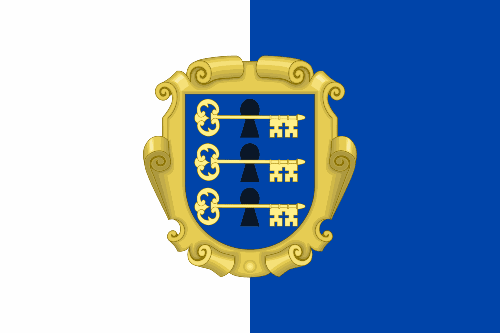
Unfortunately, there are missing informations (like colors) that impedes me of reconstructing the flag with exactitude. But the informations are enough to create my own flag proposal:


The locks are an essential symbol of Couto Misto, that relates to its politics: the laws were decided by citizens, then put on a trunk with three locks, that could only be open if the three judges (one nominated by each village, the heads of state of the Couto Misto) agreed, as each one had his own key; honorary judges are annually elected until now. The background of the flag is based on the ancient flag of the country, with a coat of arms with three locks and three keys inserted on a Baroque-style heraldic console (as used by other microstates, like Andorra and San Marino).

This flag could cause awareness of the history and status of Couto Misto, and could be used alternatively to the ancient flag and the flag described on the fragment above.

Your comments are welcome.
I'd like to desire a Merry Christmas and an excellent 2014 to all readers of the blog.

3 Dec 2013

Iberian Union

Last week, Samuel McKittrick released, on his blog, an excellent post about an Iberian peninsular flag. Although it's unclear if European Union is good or bad for a future federation or confederation between Portugal and Spain, being Latin American, I'm personally favorable to stronger ties between the two countries, specially in cultural aspects.

Below, you'll find the currently most popular Iberist flag, followed by two designs by Sammy:
Proposal by Sinibald di Mas i Sans (1854), with the colors of Portugal coat of arms (blue and white, also used in then flag) and the colors of Spanish flag (red and yellow).

Proposal #1 by Samuel McKittrick, with the union of both Spanish and Portuguese flags, and coat of arms of Spain with Portugal in highlight position.

Proposal #2 by Samuel McKittrick, with the union of both Spanish and Portuguese flags, and two stars for the two countries.

I like the designs, but I decided it would be fun to go on a different approach. Here's what I came:

This design is inspired by Union Jack and other similar designs. The blue cross on white was the first coat of arms of Portugal, and survives on current coat of arms of that country. The knotted (said raguly in heraldic language) red saltire on white is the famous "cross of Burgundy", used as merchant ensign (specially in former Spanish America), among other uses, and still present on the personal coat of arms of Spanish monarchs. I also made versions with the cross of Order of Christ in red and blue.

As a bonus, a what-if. Portugal and Spain had a joint candidate to host the 2018 football World Cup. If they won, I think this design, inspired by candidature logo, could be used to promote the tournament:

Your comments are welcome.
Don't forget to visit Sammy's post here.

11 Nov 2013

Pan-celticism

A thread on Flags Forum gave me the idea to resurrect an old sketch I made to represent the Celtic League but de facto all the pan-Celtic movement i.e. the supporter to bigger contact between the "Celtic nations".

There isn't an official pan-Celtic, but two flags are most commonly used. This is the most popular:

This flag is made with the amalgamation of flags of seven Celtic nations, from top left, in clockwise direction: Galicia, Ireland (in this case, not only the Republic of Ireland, but in a pan-Irish context), Scotland, Cornwall, Isle of Man, Wales and Brittany. Other common variant have only the six original celtic nations, removing Galicia. In the center, a triskelion, a motif common in celtic art.

The other one is a proposal by Robert Berthelier in the 1950s:

This flag have green and golden yellow colors, commonly associated with the Celts, and two conjoined triskelions (in the style of a celtic knot), representing three Gaelic peoples - Scot, Irish and Manx - and three Brittonic peoples - Welsh, Cornish and Breton.

The sketch that I had (as said in first paragraph) is heavily influenced by Andrew Boada's amazing "Irish Celtic Cross". Here is it:

This flag has the same colors of the Berthelier's proposal, with the addition of white. It represents a Celtic cross, but touching the borders instead of square as the latter is used by Neo-Nazis. I like how this flag is simple and vivid. But, to avoid any misconception, I made the reference to celtic flag much more subtle on my next proposal:

It's very much like the anterior flag, with the exception that a white triskelion was added on the center of the flag.

As you can see, the designs don't have any very original approach, but I think them may work well.

Your comments are always welcome.
I've been making the last posts trying to fix the issue of multiple blank lines, specially on cell phones. Comment if it still appear on your browser.

21 Oct 2012

Aragon (Spain)

Simplifications are sometimes great issues: what to keep and what to remove? This was the big question I found when doing my Aragon proposal. First, see the current flag:


This flag is complicated (like many Spanish flags). The simplest simplification would keep only the stripes, but we're too late: it's yet used by neighbor and related autonomous community of Catalonia; both were under rule of former Crown of Aragon. So it's needed to choose a symbol to make the flag unique. Therefore we need to look at Aragon coat of arms:

  • At first quarter, the arms of the County of Sobrarbe. Too complicated to be in the flag.
  • At second quarter, the arms attributed to Iñigo Arista, the first king of Navarre and probably count of Sobrarbe. There's no evidence it was really used, but it's a cool symbol.
  • At third quarter, an allusion to the flag used in the Battle of Alcoraz (1096), during the war against Moors. This is used as flag of Sardinia (the Moor heads are, in Sardinian flag, incorrectly turned to right since 1999). A plain version (St. George's cross) is also very popular, but it's the same insignia used by England, Milan, Genoa and many others.
  • At fourth flag, the arms of Crown of Aragon, currently held by Catalonia. Also, combining vertical and horizontal stripes would create an undesired effect.

The nationalists use a blue canton with a white star, or a centered red star, but I won't use them because of their political connotations. So, the choice was the Cross of Iñigo Arista. I made two variant versions using this symbol: the flag is divided slightly differently. See them:


I think the results are interesting.

What do you think about the post? Your comment is welcome!
Talking about so old arms can cause controversy, because the historic sources are sometimes contradictory  If you have a different information, please share it on comment box.