28 Feb 2013

Anniversary's Post

I thought my first blog post was February 26th 2012, but it seems the correct date was February 19th. However, it's visible that the blog just completed its first anniversary! Firstly, I'd like to thank very much every reader: the numbers are just incredible. It grew up very much this year and gained two brothers - the Flag Review and the Flags of U.S. States -, although, for me, they are almost the same blog.

Goals to next year


Some flag-istic goals I'd like to achieve before the next birthday. Between parenthesis, an approximated chance to achieve it.
  • A year full of posts (90%);
  • Keep all blogs alive (80%);
  • Complete the US states series (95%);
  • Complete my Brazilian capital flags series (70%);
  • Keep posting on Flags Forum (80%);
  • Complete my personal coat of arms (60%);
  • Achieve a real change with Vexillology Wiki (10%);
  • Establish a Brazilian vexillology society (30%).
Next year I'll see what we completed.

The best of the year


My personal favorites of the year. I'd like to see your favorites, too.
Catamarca (Argentina)
Rio Grande do Norte (Brazil)
Guangxi Zhuang (China)
Los Lagos (Chile)
Araucanía (Chile)

And you, what's your favorites? Please, leave a comment.

Gain a gift!


No, I'm not giving iPhones. The way I chose to thank for the reader is the following: choose any subject (yes, anything!) and I'll design a proposal to it, the soonest possible. Don't be afraid, don't be shy, participate!

Thanks again, thanks a million times! This post is specially open to suggestions, critiques, questions, etc. Don't forget to give your comment!
Sorry, I had to take a pause to celebrate, but a new flag in next week!

18 Feb 2013

Channel Islands (United Kingdom)

The Channel Islands is the name used to collectively refer to the islands in the English Channel, that divides the Great Britain and the France (and the rest of continental Europe). They are constituted by two different British crown dependencies, Jersey and Guernsey, reminiscent of the Duchy of Normandy. There were discussed on Flags Forum about the possibility of a possible independent federated Channel Islands. I prefer to discuss about a "cultural Channel Islands flag".

I don't think the best flag would merge the Jersey and Guernsey, for many reasons: it looks like a science fiction or alternate history flag (they use very much that resource) and it would look very unoriginal considering its neighbor and dependent of the United Kingdom, specially because traditional Guernsey flag is identical to St. George's cross and traditional Jersey flag is identical to St. Patrick's cross. However, if you disagree with me, you can see some proposals on the link below.

What's a big connection between all the islands? The former Duchy of Normandy, I guess. I think the ideal inspiration should be the banner of William the Conqueror. Why? He was maybe the most successful Duke of Normandy, and his achievements included becoming the first Norman king of England. It's how his banner looks like on Bayeux Tapestry (see source):


The best part to be used is the center-left, that's actually what looks more like a flag. The proof this banner is relevant: it inspired the flag of Guernsey. It's my proposal:


The great advantage of this flag is that it's very inserted on Channel Islands root, while not resembling the symbols used in United Kingdom properly nor in French Normandy; so it's very adequate to be used as a "Channel Islands cultural flag".

What's your (good or bad) opinion about this post? Please, leave a comment.
Next week is blog's first birthday's special post. Wait!

12 Feb 2013

Recife (Pernambuco, Brazil)

Since it's Carnival, I'll update my Brazilian capital flags with a city with a very famous and traditional Carnival:    Recife, whose Carnival is related to the twin city, Olinda. Let's take a look to Recife flag:


The basic inspiration to this flag is Pernambuco state flag, that, in its turn, has its origins on a flag used on 1817 Pernambucan Revolt (the only difference is that there were three stars in place of only one). See Pernambuco current flag:


Many elements are common on both flags: the blue and white backgrounds, the golden star and sun and the red cross. The common symbolism is very obvious: blue is for sky, white stands for peace, star is for the Brazilian federation, sun for climate but also energy, strength, cross for Christianism (the 1817 Revolt is also known as the "Priests' Revolt").

The Pernambuco flag has a rainbow, standing for people's pluralism. Exclusive to Recife flag, there are the Latin motto "Virtus et Fides" ("Force and Faith") and a crowned lion, related to both Pernambuco's nickname "Leão do Norte" ("[Brazilian] North Lion"), because of its history of engagement, and the coat of arms of the Prince John Maurice of Nassau, the administrator of Dutch territories on Brazil (whose headquarters were on Pernambuco) that transformed Recife (then "Mauritsstad") in one of most developed cities of American continent at the time.

I really like the Recife flag, although some details, specially the words, left over. My ideas:


I prefer most the second, that resembles even more current flag. This set of colors is very original, but you can change it for a more traditional one:


I think the last, however, is the most probable of being adopted.

Your comment is very important. Please, leave a comment! If possible, follow the blog.
Now that I am talking about Carnival and Recife, a curiosity: according to Guinness Book, Recife has the big Carnival parade of the world, the Galo da Madrugada ("Midnight Rooster"). In 2013, it's claimed to have united 2.5 million people (Recife has only 1.5 million inhabitants).

1 Feb 2013

Araucanía (Chile)

This is a flag that I done some time ago, but waited to publish because I was doing too many posts about Chile. But I think it's a good time to publish what I consider one of my best flags.

Araucanía is an administrative region right on the center of Chile, with a strong relation with native culture. This is Araucanía current flag:


This flag is a blue-white-red tricolor; I really don't know what these colors mean. The shield, however, is interesting: it consists of a black and a red partition, with six white rhombuses, symbols very used in Mapuche art, and a white tapalacucha, a Mapuche neck jewel. The coat of arms is ornamented by a copihue (native flower), a snowy mountains and two araucarias, a common tree in the southern South America and very abundant in the region.

A small change in the flag would be changing the stripes colors by the flag of the Kingdom of Araucanía and Patagonia, a government-in-exile ruled by a French monarch and a council of Mapuche tribal chiefs, but it could generate controversy over non-indigene Chileans.

My proposals is simpler and more effective:


The first and third stripes are taken from region's coat of arms. In central stripe, a stylized araucaria, a symbol with strong local identity. I think it would fly well in Araucanian skies.

Your comment is very welcome!
If you're interested in blog posts, you can receive blog updates on Google Reader or your preference e-mail. Subscription boxes are in the right of the page.

23 Jan 2013

Twin flags

Many flags are similar between themselves; others are almost identical. Between the national flags, it can be an issue: UN tried to convince Romania or Chad to change their almost identical flags, but both denied. But these attempts can have results: Liechtenstein added a crown to its flag to avoid the confusion with Haitian flag. Here are some unsolved examples:

Part I: Luxembourg and Netherlands

LuxembourgNetherlands

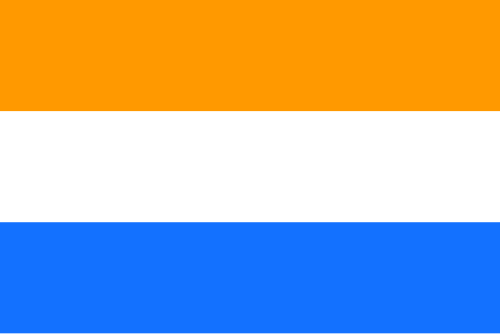
The colors of Luxembourg flag are based on the arms of Grand-Duke of Luxembourg, the head of state. Netherlands adopted those colors during the Batavian Republic, inspired by French revolutionary colors and as rejection to orange-white-blue Prince's Flag. In this specific case, the similarity is even worse because they are very near countries, although don't sharing borders.

But this issue is very near to solution: in 2007, the Luxembourg government approved the use of the banner of arms of Grand-Duchy (also used as naval ensign) as civil flag inside Luxembourger territory along with national flag, and someday it can totally supersede Luxembourg tricolor. It's the banner of arms:


This flag is much cooler, and much more relevant to the country, the reasons it has gained popular approval last years.

Part II: Andorra, Chad, Moldova and Romania


AndorraChad
MoldovaRomania

Andorra and Moldova at least use to put a coat of arms on it, but it doesn't work that well. Romania used to put their coat of arms, too, but it's a little in disuse. This issue is even more dramatic because Moldova and Romania share borders, so it's harder to know where you're passing to other side of border.

Andorra colors is a French tricolor with white and red changed by Spanish yellow and red, because Andorra is between France and Spain, and the co-princes of Andorra are the president of France and the bishop of Urgell (a Spanish Catholic diocese). It's my proposal to Andorra:


The yellow and red nine stripes (the senyera) is the arms of Catalonia, the Spanish autonomous community nearest Andorra, and where the See of Urgell is located. It's present in Andorra coat of arms (more above). The blue with the two fleurs-de-lis represent French condominium over Andorra. The number of fleur-de-lis represents the curious case of Andorra and its two co-princes.

The current design of Chad flag is inspired by pan-African colors, but with blue instead of green to avoid confusion with Mali (turning it identical to Romania...). My proposal is based on its coat of arms. See:


Moldova flag origin is exactly the flag of neighbor Romania with Moldovan coat of arms. My proposal is based on its coat of arms — a similar, but more complex flag, was yet proposed. My rendition:


I think this flag is easier to be changed. A flag based on Armed Forces flag or the flag of ancient Principality of Moldova are other options, in my opinion.

To Romania, a horizontal tricolor, used before the current vertical flag, can be an option. See:


It's OK, but I can come with a design by myself:


It represents a legend that states that the tricolor is a union of blue and red from Moldavia and blue and yellow from Transylvania. However I think Romania would be last to change its flag.

Part III: Indonesia and Monaco

IndonesiaMonaco

Both countries has excellent alternatives from their pasts and presents, so I don't know why they insist to keep the issue.

For Indonesia, there's the flag of Majapahit Empire, currently used as naval ensign and naval jack, consisting of nine red and white stripes:


For Monaco, there's other very reasonable flag: the banner of arms of House of Grimaldi (Monaco royal family), used many times unofficially, specially in 17th century, but still present in rare occasions (also unofficially):


This flag is so Monegasque in origin and use that I can't see why it's not used officially.

Part IV: American seals-on-bedsheet

Many USA state flags use a seal or a coat of arms on a blue background (see), what make them almost unrecognizable in distance. You can see my proposals to USA states on my blog, and by many other authors at Vexillology Wiki. I highly recommend the visit!

Your comment is very important to the blog. Leave a comment, please.
It's an early gift in commemoration to the first birthday of the blog, in February 19th.

16 Jan 2013

Ceará (Brazil) [II]

To read the original post, click here.

Last year, I ran a series about Brazilian state flags (the epilogue of series can be seen here). After that, unsatisfied with my early proposal to Rio Grande do Norte, I made a new one. I decided that I'd redo my Ceará flag in a next opportunity, and this is the time. First, look at current state flag and, after that, my early proposal:


You can see a complete rationale about problems in current flag in original post, the biggest of them, obviously, is the excessive similarity with Brazil national flag. I like my early proposal because it represents Ceará state in all its nuances. But the result is maybe too complicated to be used as a flag (I still think it could do a good banner of arms), so I decided to returned to simplicity.

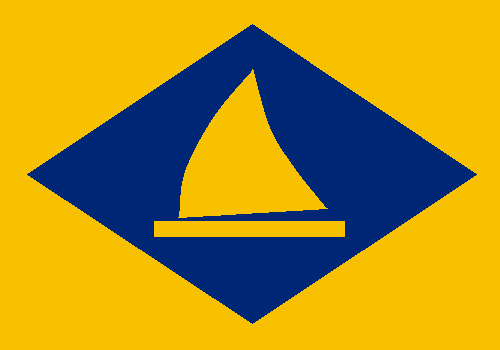
My first decision was make the reference to Brazil flag present in current flag, but in a more subtle way: keeping the lozenge layout, but changing the colors. It'll be charged with the jangada (that kind of raft you can see on both flags above). So I come with two proposals:


The yellow background represents the beaches, symbols of that sunny state, while blue is for the sea (alternatively, they can represent, respectively, the semi-arid interior and the dikes), where navigates the jangada. The first proposal uses a yellow raft, keeping the flag with only two colors, what's a great deal in manufacturing aspect. But the second, with a white one, shakes my heart with more intensity (notice that a jangada has, naturally, a white candle). What do you prefer?

Please, send your comment. It's important to the blog.
Soon you'll see my proposal to Fortaleza, capital city of Ceará. Wait!

10 Jan 2013

Fiji

Fiji is going to approve a new Constitution, and it was confirmed that the national flag will be changed. First, let's see current Fiji flag:


The flag of Fiji was chose in a contest in 1970. The winner proposal was very simple: a light blue flag (representing Pacific Ocean), with national coat of arms and United Jack on canton. It was confirmed that the Union Jack will be removed, so I tried not to be much monarchist. And I tried to represent Fiji itself in place of current government. This was the result:

Although I think Fiji flag is aesthetically poor, I tried to take some resemblance, because it's a popular flag. The white dove is a symbol of peace. It's present on Fiji current coat of arms and in a previous, precolonial, flag. The green palm tree comes from coat of arms, too, and from national rugby team logo. Blue continues to symbolize the Pacific Ocean, but also sky and stability. Green is for land and hope. The dove, that traditionally should be turned to left, is turned to right like if facing Fiji's future.

Every comment is welcome.
This is a blog about flags, not Politics!